You’re tackling knit fabrics, a notoriously tricky material that loves to slip and skip stitches. The right machine changes everything, preventing that frustration and giving you smooth, durable seams. So, which three models actually deliver on this promise without breaking the bank? Let’s break down your best options.
| Portable Handheld Sewing Machine for Adults – Mini Hand Held Sewing machine |  | Most Portable | Power Source: 4 AA batteries or USB cable | Weight: 3.2 ounces | Dimensions (L x W x H): 7 x 2 x 3 inches | VIEW LATEST PRICE | Read Our Analysis |
| Handheld Electric Mini Sewing Machine for Beginners | Budget Pick | Power Source: 4 AA batteries or USB cable | Weight: Lightweight (exact weight not specified) | Dimensions (L x W x H): 1.03 x 1.06 x 2.36 inches | VIEW LATEST PRICE | Read Our Analysis | |
| Brother XM2701 Sewing Machine 27 Stitches 6 Feet |  | Best Overall | Power Source: Electric corded (AC power) | Weight: 12.6 pounds | Dimensions (L x W x H): 15.3 x 12.1 x 5.9 inches | VIEW LATEST PRICE | Read Our Analysis |
More Details on Our Top Picks
Portable Handheld Sewing Machine for Adults – Mini Hand Held Sewing machine
If you’re hunting for the most portable sewing fix, this mini handheld model is your best bet. It’s a featherlight 3.2 ounces, measuring just 7 by 2 by 3 inches, so you’ll toss it in a bag without a second thought. You skip the threading nightmare entirely, sewing right out of the box for hems, patches, or denim tears. Power it with four AA batteries or the included USB cable, plugging into a wall adapter or power bank. This DRAWSKIN runs cordless anywhere, and its durable build handles quick fixes with ease. You’ll rate it highly, too, given its 4.9-star buzz.
- Power Source:4 AA batteries or USB cable
- Weight:3.2 ounces
- Dimensions (L x W x H):7 x 2 x 3 inches
- Included Accessories:Complete sewing kit (details not fully listed)
- Primary Use Case:Quick repairs, hemming, patching, on-the-go sewing
- Fabric Compatibility:Clothes, pants, curtains, denim, fabric projects
- Additional Feature:Dual power options (batteries/USB)
- Additional Feature:Instant sewing, no threading hassle
- Additional Feature:Compact design for travel/emergency repairs
Handheld Electric Mini Sewing Machine for Beginners
You’re looking for a budget pick that handles knit fabrics without the bulk? This mini electric machine is your go to. It’s lightweight and ergonomic, so you won’t get hand fatigue during quick repairs on knits like t shirts or leggings. It handles fabrics up to 1.8mm thick. You get two power options: cordless with 4 AA batteries or USB connection. No complex setup. Just a one button start. The kit includes bobbins, a needle threader, scissors, and instructions. It’s perfect for hemming or fixing torn seams. A 4.8 star rating backs its simplicity.
- Power Source:4 AA batteries or USB cable
- Weight:Lightweight (exact weight not specified)
- Dimensions (L x W x H):1.03 x 1.06 x 2.36 inches
- Included Accessories:Machine, bobbins, tape measure, needle threader, scissors, pins, USB cable, fabric samples, instructions
- Primary Use Case:Quick repairs, hemming, DIY crafts, family projects
- Fabric Compatibility:Fabrics up to 1.8mm thick (silk, denim, leather, wool)
- Additional Feature:One-button start, no complex setup
- Additional Feature:Handles fabric up to 1.8mm thick
- Additional Feature:Complete kit includes fabric samples
Brother XM2701 Sewing Machine 27 Stitches 6 Feet
The Brother XM2701 dominates as the go-to machine for knit fabrics. You’ll love its 27 built-in stitches, including stretch and zigzag options that handle knits without skipped stitches. The automatic needle threader saves your eyes, and the jam-resistant drop-in bobbin keeps you sewing.
You get six feet: buttonhole, zipper, zigzag, narrow hemmer, blind stitch, and button sewing. That’s everything you need for knit projects like cuffs and sleeves.
Weighing only 12.6 pounds, you can move it easily. And with a 25-year warranty and free lifetime support, you’ve got backup. It’s lightweight, user-friendly, and built for consistent stitch quality.
- Power Source:Electric corded (AC power)
- Weight:12.6 pounds
- Dimensions (L x W x H):15.3 x 12.1 x 5.9 inches
- Included Accessories:6 sewing feet, 3-piece needle set, twin needle, 4 bobbins, instructional DVD, manual
- Primary Use Case:Full-featured sewing, wide range of projects, suitable for beginners to advanced
- Fabric Compatibility:Various fabric types (no specific thickness limit stated)
- Additional Feature:27 built-in stitches included
- Additional Feature:Automatic needle threader system
- Additional Feature:Free arm for cuffs/sleeves sewing
Factors to Consider When Choosing a Sewing Machine for Knit Fabrics
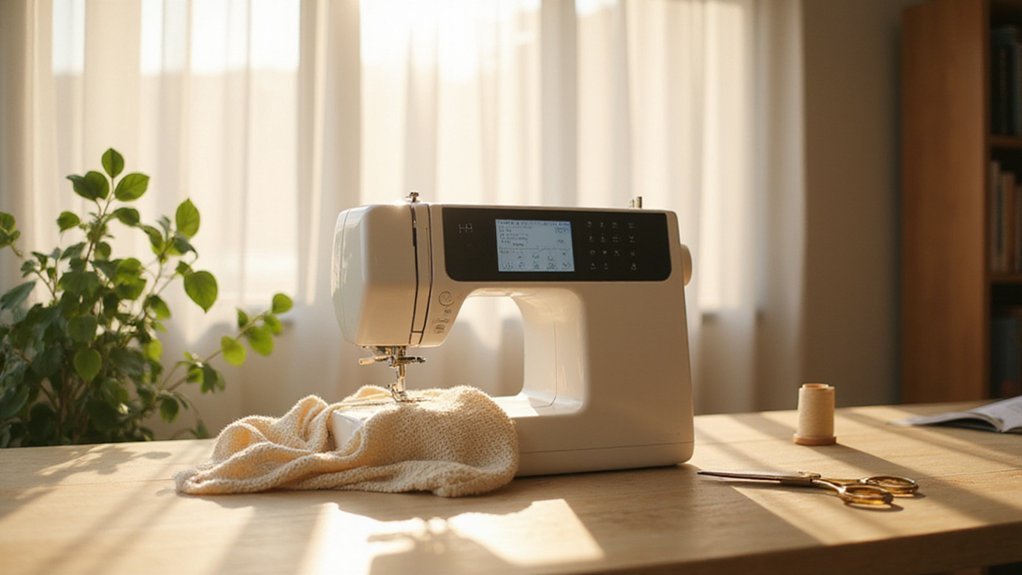
When you’re shopping for a knit-friendly machine, your first move is to check the stitch type options, because you’ll want a dedicated stretch stitch or a narrow zigzag to keep seams flexible instead of snapping. You’ll also need to look at the needle selection guide, since ballpoint or stretch needles are non-negotiable for gliding between threads without cutting them, and a machine that allows easy needle changes saves you constant frustration. And pay close attention to the fabric feed system, because a walking foot or dual-feed mechanism prevents that dreaded wavy edge, while adjustable tension control settings give you the fine-tuning power to handle slippery spandex or cozy jersey with confidence, so you don’t end up with puckered, uneven seams.
Stitch Type Options
Two stitch categories matter most for knits: zigzag variations and true stretch stitches. You’ll want a machine that offers both narrow and wider zigzag options since these secure edges without causing fraying or pilling. But don’t stop there. A dedicated stretch stitch is your best friend for seams that move with the fabric, not against it. Look for machines with multiple stitch choices, including specialized ones like decorative or overlock stitches. These improve your finish and durability on garments you actually wear. And here’s a pro tip: you need the ability to adjust stitch length and width. This lets you customize stitches for thicker or stretchier knits. So when you’re shopping, prioritize machines that give you these adjustments without fuss. You’ll sew with confidence, knowing each stitch flexes and holds as it should!
Needle Selection Guide
If you want to avoid puckering, skipped stitches, and broken threads, your needle choice is just as critical as your machine. Knit fabrics demand a rounded tip, so grab a stretch or ballpoint needle. That shape gently pushes fibers apart instead of slicing through them, which is your ticket to clean seams.
For lightweight knits, reach for a size 70/10 or 75/11. Heavier, thicker knits? Bump it up to 90/14 or 100/16. Match the needle to the fabric’s weight, and you’ll dodge most fiber damage.
Don’t forget elasticity. A stretch needle boosts stitch flexibility, so your seams won’t snap mid-wear. And here’s the kicker: swap your needle every 6 to 8 hours of sewing, or sooner if it feels dull. A fresh point makes all the difference, trust me.
Fabric Feed System
So, what makes a sewing machine truly handle knit fabrics without a fight? It all comes down to the fabric feed system. You need a system that smoothly moves your knits without puckering or stretching them out of shape.
Look for a machine with a differential feed mechanism. That’s your secret weapon against wavy seams and skipped stitches. It adjusts the speed of your top and bottom feed dogs, so the fabric doesn’t get distorted as you sew. Most machines let you set this feature specifically for stretchy fabrics.
Without a reliable feed, you’ll get uneven stitches and frustrating stretching. Here’s what to check:
- Adjustable feed pressure sets the right tension for your knit.
- A dedicated stretch fabric guide keeps everything aligned.
A solid feed system is your foundation. Without it, even the best needle won’t save you from rippled seams.
Stretch Stitch Capability
Why do some sewing machines glide through knits while others leave you with popped seams and frustration? It’s often the stretch stitch capability. You need a machine that creates flexible, elastic seams, moving with your fabric instead of snapping. Look for specialized stitches like stretch, zigzag, or overlock; these are your knit-friendly workhorses.
Check that the stitch length and width are adjustable. That’s your control for durability, letting you fine-tune a seam for a lightweight jersey or a heavy ponte. Seamlessly switching between straight and stretch stitches? Essential. It prevents puckering and keeps your garment’s integrity intact.
- Stretch stitch for give.
- Zigzag for edge finishing.
- Overlock for that clean, professional look.
Prioritize machines where stretch stitch quality looks crisp, not loopy. You’ll enjoy durable, professional results without the wrestling match.
Tension Control Settings
How do you keep a knit seam from turning into a wavy mess or a puckered disaster? It starts with tension control, plain and simple. You need a machine that lets you dial in that pressure precisely, whether via a classic dial or digital readout, because knits stretch and shift under too much or too little thread tension.
Get this wrong, and you’ll see skipped stitches or fabric that ripples like a flag. Look for a model with a broad tension range, not just a one-size-fits-all preset. Some advanced machines even auto-adjust to match your fabric’s stretch, which saves you headaches.
For best results, tweak tension gradually on a scrap piece first. Too loose, and loops appear; too tight, and the seam puckers. Your goal is a flat, flexible stitch that moves with the knit, not against it. Precise control here means your seams stay elastic and your garments keep their shape, wear after wear.