Coverstitch machines can feel like overkill until you need a clean hem on stretch fabric without that wavy mess. But once you see the difference a dedicated coverstitch makes, you’ll wonder how you ever settled for less. Let’s walk through ten upgrades worth your attention, starting with the machines that deliver both versatility and professional finishes.
Serger Sewing Machine, Four-thread Capability Coverstitch
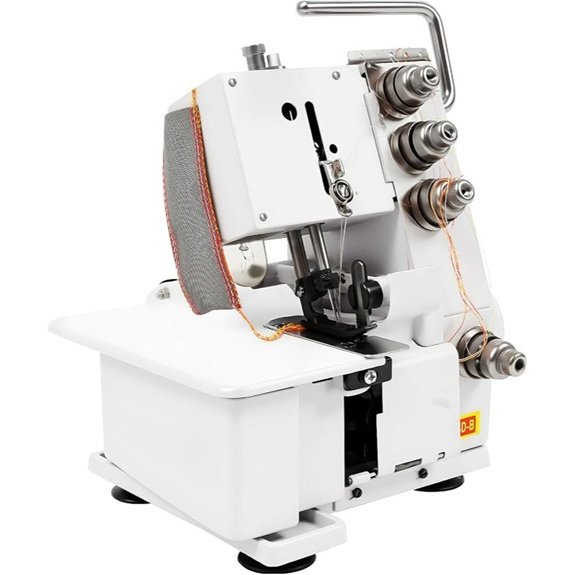
If you’re hunting for a machine that can handle both overlocking and coverstitch work without making you switch setups, the four-thread serger with coverstitch capability is your sweet spot. Its 100W motor zips through silk and denim alike at 1200 stitches per minute, giving you durable, unravel-resistant seams. You’ll appreciate adjustable stitch width (0.1 to 0.13 inches needle pitch) and individual thread tension controls to fine-tune results for cotton or thicker fabrics.
You get a sturdy cast iron frame that resists rust and corrosion, plus an integrated LED light that keeps your workspace bright. A heat sink window prevents overheating, and the foot controller lets you manage speed hands free. At 16.5 pounds, it’s a compact workhorse for your home projects!
Janome Cover Pro 1000CPX Coverstitch Machine with Exclusive Bonus Bundle
https://m.media-amazon.com/images/I/71sPIhex59L._AC_SX679_.jpg
You want professional quality finishes on knits and activewear, but you don’t have room for a full industrial machine. That’s where Janome’s Cover Pro 1000CPX steps in, delivering professional grade results from a compact, 15 pound frame. It’s built with metal construction, so it’s sturdy enough for serious home sewing projects. The exclusive bonus bundle adds real value: you’ll get two packs of Schmetz ELx705 needles, an adjustable seam guide, and a needle threader. That seam guide is a lifesaver for consistent seam allowances. With a 4.6 out of 5 star rating from 218 customers, this machine earns its reputation.
Janome CoverPro 900CPX Coverstitch Machine With Bonus Accessories
https://m.media-amazon.com/images/I/71ty29xm2XL._AC_SX679_.jpg
This coverstitch machine is built for home sewists who demand professional hem finishes. You’ll get that factory-wedding-hem quality right at your fingertips, without the industrial footprint. The long arm gives you plenty of room to maneuver bulky projects, so you’re not wrestling fabric through tight spaces.
Here’s what makes it a smart upgrade:
- Metal construction means it’s built to last, even with frequent use.
- High-speed stitching lets you finish hems quickly and smoothly on stretchy knits.
- Bonus accessories, including the Narrow Elastic Foot Collection and Hem Guide, boost your precision right out of the box.
Weighing in at 23 pounds, it’s sturdy but still manageable for a home setup. With a solid 4.1-star average from owners, it’s a dependable workhorse. And you’ll get Janome’s support when you need it, so you’re never left hanging mid-project.
Janome CoverPro 1000CPX Coverstitch Machine
https://m.media-amazon.com/images/I/511z82tgEWL._AC_SX679_.jpg
Serious knit garment sewists seeking store-quality finishes will find their match in the Janome CoverPro 1000CPX. You get three stitch configurations: 2-thread chain stitch, 3-thread cover stitch, and 4-thread triple cover stitch. That means you can tackle basic hems, decorative designs, or wide cover seams on jersey, ponte, and spandex. The exclusive free arm removes entirely, so you stitch onto finished cuffs and necklines without opening seams. Plus, you enjoy speed up to 1,000 stitches per minute with color-coded guides and a seam tightening system. Differential feed ranges from 0.5 to 2.25, giving you precise control over fabric density. And the extra-large 4 x 5.5 inch bed provides ample workspace for deep hems.
Janome CoverPro 2000CPX Coverstitch Machine
https://m.media-amazon.com/images/I/51EX4B+V+iL._AC_SX679_.jpg
If you sew knits regularly, the Janome CoverPro 2000CPX is your ticket to professional-looking hems without the learning curve of a serger. You get three stitch configurations: the 1-needle chain stitch, a 2-needle cover stitch, or the triple 3-needle option. Adjust stitch length from 1 to 4mm, and dial in the differential feed between 0.5 and 2.25. That prevents puckering on lightweight jersey or stretching on dense ponte. The exclusive removable free arm lets you tackle cuffs and necklines with ease. Plus, you get color-coded guides and an extra-large 4″ x 5.5″ bed for big projects. It’s stable, fast at 1,000 SPM, and built to last.
Bernette b42 Funlock Coverstitch Machine
https://m.media-amazon.com/images/I/51oLvo0CQOL._AC_SX679_.jpg
Do you sew through denim one day and delicate knits the next? The Bernette b42 Funlock handles both without fuss. This heavy duty machine gives you three coverstitch widths: 2.8mm for fine fabrics and 5.6mm for sturdy seams. You also get a chain stitch for durable, stretchable hems. You’ll love the separate needle and looper threaders, saving you time. Adjust the presser foot easily for different thicknesses, and see your settings on the clear LCD display. The bright LED light keeps your stitching precise. And with the extension table, large quilting projects become manageable. It’s a portable workhorse for professional finishes at home.
Consew 14TU858 3-Thread 2-Needle Portable “Coverlock” Coverstitch Machine
https://m.media-amazon.com/images/I/41Oyl0qLFSL._AC_.jpg
Consew 14TU858 brings industrial-style cover stitching home without the heavy footprint. You’re getting a 3-thread, 2-needle machine that handles stretch knits for hems, activewear, or repairs, with adjustable stitch length and tension for dialing in consistent results. It’s compact at 11.8 by 12.2 by 12.6 inches and weighs just 1.5 pounds, so you can tuck it away easily.
- Metal build holds up to regular use.
- Corded power keeps it steady during longer projects.
But here’s the rub: user feedback averages around 2.3 stars, which suggests tension quirks or feed issues might frustrate you. It’s not a top seller, ranked lower in sewing categories. If you’re set on a portable coverlock, weigh the price against potential setup headaches. For casual mending, it might suffice; for daily production, you’ll likely outgrow it fast.
CoverPro 900CPX Coverstitch Machine
https://m.media-amazon.com/images/I/71ty29xm2XL._AC_SX679_.jpg
The Janome CoverPro 900CPX is your best bet if you want industrial grade coverstitch power without leaving your home sewing space. Weighing in at 15 pounds and built from sturdy metal, this machine operates like a traditional sewing machine but delivers advanced coverstitch results. Its long arm design and heavy duty cover hem capability handle diverse projects with ease. Customers rate it 4.5 out of 5 stars across 70 reviews, so you’re getting a proven performer. Plus, it ranks in the top 100 in its category. Check warranty details with Janome for support.
Brother 2340CV Coverstitch Serger Sewing Machine
https://m.media-amazon.com/images/I/61yNRt3f4KL._AC_SX679_.jpg
If you’re chasing professional-quality hemming on stretchy knits, the Brother 2340CV is your machine. Its metal frame keeps things stable, even at 1,100 stitches per minute. You’ll get two, three, or four needle cover stitches, with widths from 3 to 6 mm for thicker fabrics. The adjustable differential feed (0.7 to 2.0 mm) stops that dreaded wavy edge. Threading? Color-coded guides and a fast looper system make setup painless. And you’ll find snap-on feet, plus a presser foot dial for precision.
You get a 25-year warranty, which is generous for the price. The kit includes needles, thread nets, tweezers, and a soft cover. One tip: keep the machine at 120V US power; using it elsewhere voids the warranty.
For a compact workhorse, this serger delivers durable straps and clean hems without fuss.
Janome CoverPro 900CPX Coverstitch Machine
https://m.media-amazon.com/images/I/613Z9PiXlRL._AC_SX679_.jpg
Janome CoverPro 900CPX is your go-to for store-quality knit hems at home. With its free arm, you’ll zip through cuffs and necklines without opening seams. Switch between a 2-thread chain stitch and a 3-thread cover stitch using one or two needles. Adjust stitch length from 1 to 4mm, and dial in differential feed from 0.5 to 2.25 to stop puckering or stretching. The Seam Tightening System keeps tension consistent across fabrics. Plus, it sews up to 1,000 stitches per minute. That extra-large bed space handles wide hems easily. Just remove the extension for free arm access.
Factors to Consider When Choosing a Sewing Machine With Coverstitch
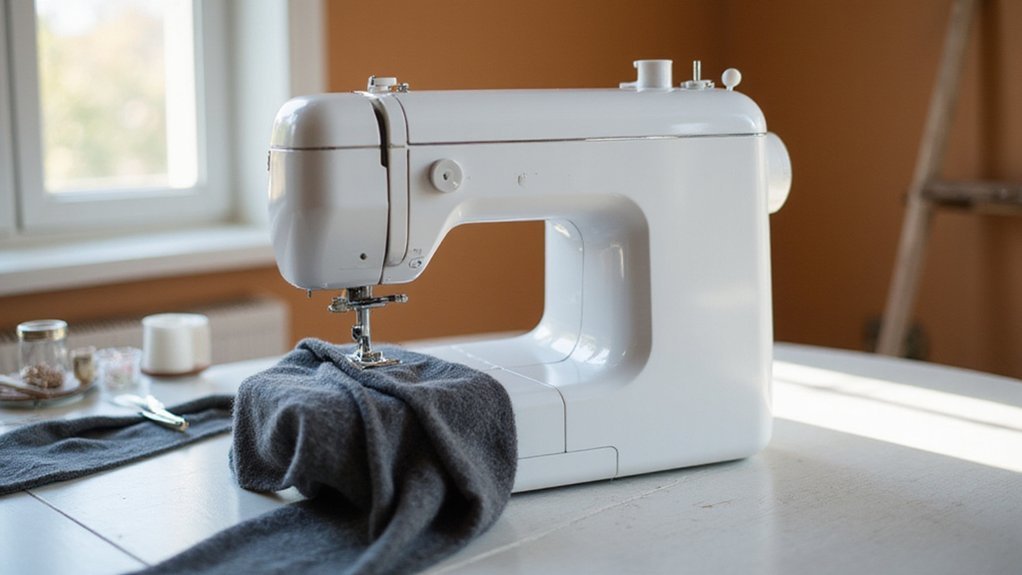
Before you commit to a coverstitch machine, you’ll want to weigh five key factors that make or break the experience. Stitch versatility determines if you can handle hems, topstitching, and decorative seams without switching machines, while build quality separates a stable workhorse from a vibrating frustration. Think about speed and efficiency for your projects, but don’t overlook ease of threading (the tension path can be a maze!) and how well the machine glides over bulky seams, since those details turn a good day of sewing into a great one.
Stitch Versatility
When you’re looking for a coverstitch machine that truly delivers, stitch versatility should be at the top of your list. You need options that flex with your projects, not a one-trick pony. Access machines offering 2, 3, and 4-thread configurations so you can switch from a delicate hem on silk to a sturdy seam on denim without blinking.
- Adjustable stitch length and width let you fine-tune everything, from narrow hems to bold, decorative finishes.
- Tri-cover and chain stitches expand your creative range, giving you professional results on knits, wovens, and heavy fabrics alike.
A versatile machine handles diverse materials seamlessly, keeping stitch quality crisp every time. You’re not just buying a tool; you’re revealing possibilities. Choose wisely, and you’ll never feel boxed in again.
Build Quality
Since you’re investing in a coverstitch machine, build quality is what separates a reliable workhorse from a frustrating purchase. You need a durable build with high-quality metal components to withstand frequent use. Heavy-duty construction keeps alignment and precision tight, so you won’t fight misaligned seams.
Look for a robust frame; it minimizes vibrations and improves stitch quality dramatically. Quality materials matter too, like corrosion-resistant coatings and reinforced parts, which boost longevity. And you’ll appreciate well-designed construction with accessible adjustment controls. They make maintenance a breeze, not a chore.
For a machine that truly lasts, prioritize metal internals over plastic. A stable, vibration-free platform delivers consistent results every time. That’s the difference between upgrading and regretting.
Speed & Efficiency
A solid build gets you halfway there, but speed and efficiency are what turn a good coverstitch machine into a true time saver. Look for a model hitting 1,000 stitches per minute; that’s roughly 20% faster than standard, which adds up when you’re hemming a stack of tees. A powerful 100W motor handles thick denim and delicate knits without bogging down, so you won’t have to slow your rhythm mid-project.
Differential feed is your secret weapon here; it adjusts to prevent puckering while you’re flying along, keeping every seam smooth without extra passes. And don’t overlook multiple stitch configurations and adjustable stitch length, which let you switch from a narrow hem to a wide coverstitch in seconds, no rethreading required. That versatility plus raw speed means you’ll finish more pieces in less time, with less fuss. Efficient machines strip away the hesitation, letting you work at your natural pace.
Ease of Threading
Ever wrestled a thread through a maze of hooks, only to curse and start over? Yeah, we’ve all been there. That’s why ease of threading is non-negotiable when picking a coverstitch machine. Look for models with color-coded guides and lay-in threading systems. They turn a tangled nightmare into a straightforward path. Automatic needle threading is a lifesaver, too, saving you time and squinting.
You’ll also want clear, accessible threading paths. Snap-on systems make setup quick, and built-in tension adjustments prevent fussy misalignments. Beginners and pros alike benefit from these ergonomic features. They cut down on mistakes and keep your stitch quality consistent, no matter the project. So don’t settle for a machine that fights you before you even start sewing. Find one that practically threads itself!
Fabric Handling
Once threading stops being the bottleneck, your focus shifts to what actually happens when fabric glides under the presser foot. You need adjustable differential feed to tame tricky fabrics like lightweight jersey without puckering, or heavy denim without stretching. Look for tension release features that keep stitch quality consistent as you switch between materials, from slippery silks to stubborn knits. A Seam Tightening System (STS) or similar tech is a game changer for achieving even tension on delicate fabrics. Also, sufficient stitch length and width adjustments let you dial in exactly what each project demands. And don’t overlook a removable free arm or extended bed space, it’s essential for tackling cuffs and necklines without wrestling the garment. Get these right, and your fabric handling becomes effortless!
Machine Weight
When you’re weighing your options, literally, remember that machine weight is more than just a number on a box; it’s a direct reflection of what you’re signing up for regarding stability, portability, and long-term durability. Heavier machines, typically over 15 pounds, reduce vibrations and help you nail precise coverstitch results. They often use metal components, boosting longevity. But you’ll need a sturdy workspace to support that heft.
Lighter models, under 10 pounds, win on portability. They’re perfect for small spaces or mobile setups. However, you might sacrifice some stability, and they can struggle with heavy duty fabrics during long sessions.
Choose based on your priorities:
- Go heavy for stability and durability.
- Go light for easy transport and compact storage.
Know your space and your sewing style before you buy.