You’re likely here because you’ve hit the same wall I did: a workshop full of flimsy cutters that choke on thick leather. Luckily, four machines rise above the rest, and they’re the ones factories swear by. But here’s the catch—the real secret isn’t just raw power; it’s how that force meets your workflow. Stick around, because the wrong frame choice could cost you double.
| 3 Ton Swing Arm Leather Cutting Machine 7.0 x 4.7 in |  | High-Force Precision | Load Capacity: 6,614 lbs (3 tons) | Working Surface Area: 7.0 x 4.7 inches | Adjustable Stroke: Not specified | VIEW LATEST PRICE | Read Our Analysis |
| VEVOR Manual Leather Cutting Machine Die Cutter |  | Compact Value Pick | Load Capacity: 3,306 lbs (1.5 tons) | Working Surface Area: 10.2 x 5.9 inches (60.18 sq in) | Adjustable Stroke: 0.47 inches (12mm) | VIEW LATEST PRICE | Read Our Analysis |
| VEVOR Leather Cutting Machine Die Cutter |  | Large-Format Power | Load Capacity: 3,306 lbs (1.5 tons) | Working Surface Area: 14.2 x 10.2 inches | Adjustable Stroke: 0.47 inches (12mm) | VIEW LATEST PRICE | Read Our Analysis |
| VEVOR Leather Cutting Machine Embossing Die Cutter |  | Versatile Midweight Choice | Load Capacity: 3,306 lbs (1.5 tons) | Working Surface Area: 11 x 5.5 inches | Adjustable Stroke: 0.47 inches (12mm) | VIEW LATEST PRICE | Read Our Analysis |
More Details on Our Top Picks
3 Ton Swing Arm Leather Cutting Machine 7.0 x 4.7 in
If you need high-force precision for demanding materials, the 3 Ton Swing Arm Leather Cutting Machine delivers. Its 6,614 lbs of downward pressure slices through 9mm+ thick leather, hard rubber, or dense foam without burrs. The swing arm rotates fully out of your way, giving you an unobstructed view and direct access. You’ll align dies in about 10 seconds, cutting waste dramatically. A 50.7 lbs carbon steel frame stops vibration cold, ensuring consistent, even cuts every time. Plus, you get an 18-piece metal die set ready to go. It’s a compact workhorse for serious production.
- Load Capacity:6,614 lbs (3 tons)
- Working Surface Area:7.0 x 4.7 inches
- Adjustable Stroke:Not specified
- Frame Material:All-carbon steel
- Base Plate Material:Not specified
- Compatible Materials:Leather, fabric, canvas, stickers, plastic, rubber, film, paper, PVC/EVA foam, non-sticky materials
- Additional Feature:Swing arm design
- Additional Feature:Includes 18-piece die set
- Additional Feature:50.7 lbs carbon steel body
VEVOR Manual Leather Cutting Machine Die Cutter
The VEVOR Manual Leather Cutting Machine is the compact value pick for budget-conscious crafters who still need serious pressing power. Don’t let its size fool you. This die cutter packs a 1.5-ton load capacity, thanks to high-strength roller bearings and a manganese steel base plate. You get a 0.47-inch adjustable pressure stroke, letting you tackle leather, fabric, PVC foam, and rubber sheets.
Key features include:
- Durable steel with black oxide coating for rust resistance.
- Limiting screws and weighted base prevent handle rebound.
- Dual guide shafts for precise cutting.
- 60.18 square inches of working surface.
It’s built tough for frequent use without breaking your budget. A smart choice for serious projects.
- Load Capacity:3,306 lbs (1.5 tons)
- Working Surface Area:10.2 x 5.9 inches (60.18 sq in)
- Adjustable Stroke:0.47 inches (12mm)
- Frame Material:High-quality steel with black oxide coating
- Base Plate Material:Manganese steel
- Compatible Materials:Leather, fabric, PVC/EVA foam, rubber sheets, plastic, medium-soft materials
- Additional Feature:Dual guide shafts
- Additional Feature:3306 lb load capacity
- Additional Feature:Black oxide coating
VEVOR Leather Cutting Machine Die Cutter
Looking for a robust die cutter that won’t break the bank? You’ve found it. The VEVOR Leather Cutting Machine packs a whopping 3,306 pound load capacity thanks to its high-strength roller bearings and manganese steel base. That’s 1.5 tons of pressing power, all in a 97.2 pound package.
Key features you’ll appreciate:
- Large embossing plate: 14.2 by 10.2 inches for bigger patterns and logos.
- Adjustable stroke: 0.47 inches (12mm) lets you work with various leather thicknesses.
- Durable construction: Alloy steel with black oxide coating resists rust and corrosion.
- Stability: Limiting screws secure the handle and reduce rebound.
It handles leather, fabric, PVC/EVA foam, plastic, rubber, and other medium-soft materials. Perfect for artisans and small manufacturers who need precise, repeatable results.
- Load Capacity:3,306 lbs (1.5 tons)
- Working Surface Area:14.2 x 10.2 inches
- Adjustable Stroke:0.47 inches (12mm)
- Frame Material:High-quality alloy steel with black oxide coating
- Base Plate Material:Manganese steel
- Compatible Materials:Leather, fabric, PVC/EVA foam, plastic, rubber, medium-soft materials
- Additional Feature:97.2 lb heavy base
- Additional Feature:Manganese steel base plate
- Additional Feature:Large 142 sq in plate
VEVOR Leather Cutting Machine Embossing Die Cutter
Start with the VEVOR Leather Cutting Machine if you want a versatile midweight choice that won’t break your budget. You get a rugged workhorse built from high-quality steel with a black oxide coating, so rust won’t slow you down. Its manganese steel base plate and high-strength roller bearings handle a massive 3,306-pound load without deforming.
And you’ll appreciate the precision: limiting screws secure the front handle to prevent rebound during embossing. The adjustable 0.47-inch stroke lets you work with various leather thicknesses, while the 11 x 5.5-inch embossing plate handles fabric leather, PVC foam, and rubber sheets. Weighing 60 pounds, it stays stable on your bench. Perfect for detailed crafting, this machine delivers industrial punch at a hobbyist price!
- Load Capacity:3,306 lbs (1.5 tons)
- Working Surface Area:11 x 5.5 inches
- Adjustable Stroke:0.47 inches (12mm)
- Frame Material:High-quality steel with black oxide coating
- Base Plate Material:Manganese steel
- Compatible Materials:Leather, fabric, PVC/EVA foam, plastics, rubber sheets, medium-soft materials
- Additional Feature:11 x 5.5 inch plate
- Additional Feature:60.1 lb total weight
- Additional Feature:Limiting screw stability
Factors to Consider When Choosing an Industrial Die Cutting Machine
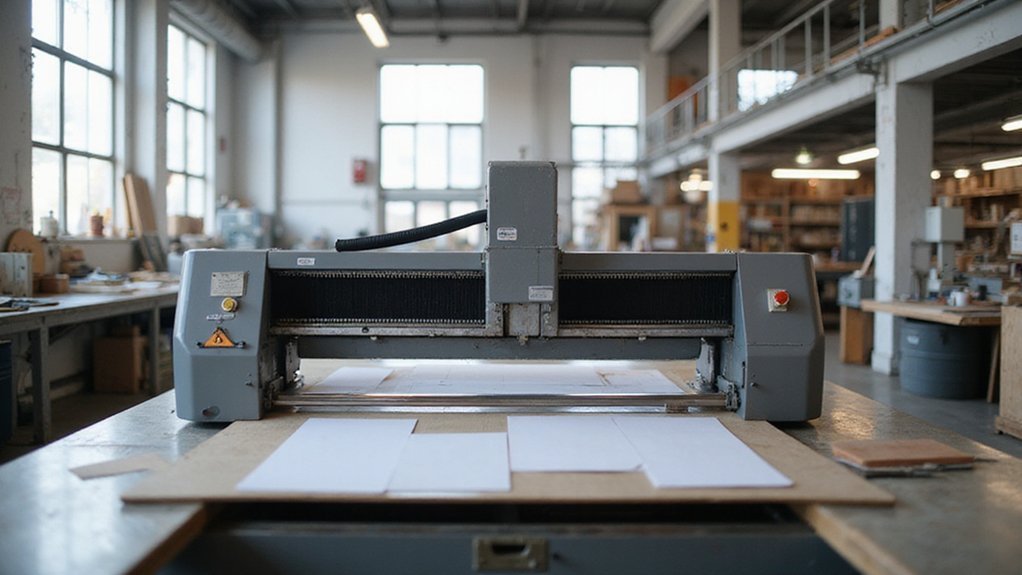
So you’re ready to choose an industrial die cutting machine, and you need to know exactly what matters. Focus on cutting force capacity first, because that determines the materials you can handle, from thick leather to rigid plastics. Then consider your material compatibility range, machine stability, work surface dimensions, and stroke height adjustment, each one directly affecting your production efficiency and final results.
Cutting Force Capacity
One of the first things you’ll need to nail down is the cutting force capacity, because it directly determines what your machine can handle. You’ll find ratings from 3 tons to over 12 tons here, so don’t guess. A higher capacity lets you cut through thicker, denser materials like full-grain leather or rubber without a fight. And if you’re stacking multiple layers, you absolutely need that extra oomph. Skimp on force, and you’ll get incomplete cuts, deformed materials, and faster die wear. That’s wasted money and time.
Material Compatibility Range
You’ve zeroed in on cutting force, but here’s where that power meets reality: material compatibility. Don’t let a high tonnage machine fail you because it can’t handle your stock. First, confirm the maximum material thickness; you’ll need support for leather, rubber, or foam that can range from a few millimeters to over 9mm. Check for compatibility with your specific materials, like full grain leather, fabric, plastics, or PVC/EVA foam. And if you’re running high volume projects, verify the machine can process multiple layers simultaneously. That adaptability saves you from constant equipment upgrades. Here’s what to verify:
- Maximum material thickness (e.g., 9mm+).
- Material types supported (leather, foam, etc.).
- Multi layer cutting capability for batch production.
Get this right, or your machine becomes an expensive paperweight.
Machine Stability & Build
Two things matter more than almost anything else when you’re picking an industrial die cutter: stability and build. You need a machine that doesn’t flinch under pressure, and that starts with heavy-duty, all-metal construction. Look for steel or alloy frames that resist flexing, not lightweight composites that wobble when things get intense. Limiting screws and weighted bases lock everything down, cutting rebound so your strokes stay precise, hit after hit. Aim for load capacities over 1.5 tons; that structural heft lets you tackle thicker, denser stock without deformation. Robust roller bearings and manganese steel components keep movement buttery and controlled. And a sturdy frame minimizes vibration, which is your secret weapon for clean, accurate cuts in high-volume runs. Don’t settle for shaky; your production line deserves rock solid.
Work Surface Dimensions
Ever looked at a job and wondered why you’re making three passes when one should do? That’s your work surface dimensions talking. A larger bed lets you cut full sheets or gang multiple small pieces in one go, boosting efficiency instantly. You’ll match it to your typical project size; a 24×36-inch surface handles big signage, while compact 12×18-inch beds suit detailed labels. But don’t squeeze oversized material onto a tiny table. You’ll waste time and create scrap. Measure your largest pattern and confirm the machine’s surface clears it comfortably. That’s non-negotiable for functionality. For example, a 30×40-inch work area often suits corrugated box production, while a 20×24-inch one fits automotive gaskets. Pick one that mirrors your workflow, and you’ll stop fighting your machine. Efficiency isn’t luck. It’s precision.
Stroke Height Adjustment
Before you settle on a machine, consider stroke height adjustment, because it directly controls the maximum material thickness you can cut or emboss—typically from 0.47 inches (12mm) up past half an inch. This isn’t just about what you can fit; it’s about how consistently you’ll nail the cut. Precise control lets you dial in the perfect pressure for different materials, preventing crushed edges or incomplete cuts. You want a machine that won’t damage your work or itself when you switch from thin paperboard to thick plastic. Look for a user-friendly adjustment mechanism; quick, tool-free changes keep your workflow humming. Here’s what a good stroke height gives you:
- Versatility: Handle everything from foams to heavy cardstock.
- Uniformity: Consistent embossing depth across every sheet.
- Protection: Prevents accidental overpressure damage.
Don’t underestimate this feature. A little adjustability goes a long way in production speed and quality.
Die Alignment Precision
Once you’ve got your stroke height dialed in, the next thing to lock down is die alignment precision, because even perfect pressure means nothing if the die lands off-kilter. Slight misalignment during setup causes uneven cuts, damaging your die and ruining product quality. That’s wasted material you can’t get back.
You need machines with full swing arms and guide shafts for precise positioning. Look for tool free alignment mechanisms; they save time and boost accuracy every single run. A quick, repeatable setup keeps you consistent across multiple projects without constant tweaking.
And don’t overlook regular calibration. Maintain those alignment components to keep precision sharp. When your die hits exactly where it should, you’ll see less waste and cleaner results. That’s the kind of reliability that keeps production moving without surprises!
Frame Construction Material
Since stroke height and alignment are locked in, let’s talk about what holds everything together: the frame construction material. This choice determines your machine’s durability and resistance to wear and corrosion. You’ll typically find steel or alloy steel frames. They’re common because they provide high strength, critical for stability during heavy duty cutting and embossing tasks.
Look for a solid, one piece frame construction. It minimizes vibrations and flexing, which means you get precise, consistent cuts every time. And don’t overlook the coating. A black oxide finish enhances corrosion resistance, prolonging the machine’s lifespan.
Also, consider weight. Heavyweight frames, like those made of high carbon steel, improve stability and reduce movement during operation. That leads directly to more accurate results. Stick with these materials, and you’ll own a machine that handles years of industrial use without losing its edge.
Accessories Included
With that solid steel frame handling the heavy lifting, now it’s time to look at what comes in the box. You want a complete set of metal dies or embossing plates right from the start, boosting your project versatility without delay. Does it include carrying cases or guide rulers? These streamline your workflow, preventing lost parts. Verify the included die set matches your material size and your intended tasks, whether that’s leather or foam. Compatibility matters for multipurpose use across fabrics and plastics. And check that replacement dies are readily available to extend the machine’s functionality later. Look for extra blades, too extra blades save you a reorder headache. A smart accessory bundle turns a good machine into your workshop’s backbone. Don’t settle for bare bones; get the toolkit you deserve!