Picture yourself guiding fabric through your sewing machine with laser-like precision, never missing a stitch. If you’ve struggled with crooked seams or uneven quilting lines, you’re not alone. Today’s laser guide technology has transformed the way sewists achieve professional results, and you’ll want to know which models deliver on their promises. Let’s explore the top five laser guides that’ll revolutionize your sewing projects in the year 2026.
ViviLux 3-in-1 Rechargeable Red Laser System for Sewing & Quilting


The ViviLux 3-in-1 laser system is perfect for sewists who need precision without constantly marking fabric. You’ll get three interchangeable heads offering line, crosshair, and dot laser options for versatile sewing applications. The tool-free magnetic mount lets you quickly attach it to any metal surface on your machine.
With a 3-hour charge time and USB compatibility, you won’t have to worry about power interruptions. While some users report alignment challenges, most praise its accuracy and time-saving benefits. At just 4 ounces and compact dimensions, it’s an unobtrusive addition to your workspace that can dramatically improve your sewing precision.
Best For: Quilters and sewists seeking precise straight-line sewing and enhanced accuracy without manual fabric marking.
Pros:
- Three versatile laser heads (line, crosshair, dot) for different sewing applications
- Tool-free magnetic mounting system for quick attachment and repositioning
- USB rechargeable with 3-hour charge time and extended battery life
Cons:
- Magnetic mount only works on metal surfaces
- Some users report alignment and stability issues
- Durability concerns with units occasionally failing after charging
HONEYSEW 3-in-1 Sewing Machine Quilting Light with Adjustable Heads
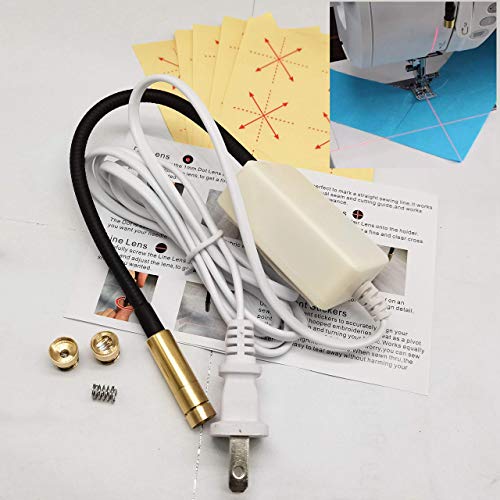
Featuring three interchangeable heads, HONEYSEW’s quilting light system offers versatility for sewists who need precise alignment across different project types. You’ll get a dot lens for needle placement, a line lens for seam guidance, and a cross-hair lens for centered embroidery work.
The hook-and-loop mounting system lets you quickly attach the light to your machine, while the flexible wand helps you position it perfectly. Though customers praise its effectiveness for precise stitching and value for money, some report issues with mounting stability and cord length. At 5.6 ounces, it’s lightweight and compact enough for most sewing setups.
Best For: Quilters and sewists seeking precise alignment and accurate stitching across different project types, particularly those working on detailed embroidery or complex quilting patterns.
Pros:
- Three interchangeable heads provide versatility for different sewing needs (dot, line, and cross-hair)
- Easy installation with hook-and-loop mounting system
- Helps achieve precise stitching and alignment for complex projects
Cons:
- Mounting stability issues reported by some users
- Power cord length may be insufficient
- Some units arrive defective or malfunction shortly after use
Perfect Alignment Laser 3 (PAL3) Crosshair Lamp for Alignment

Crafters seeking professional-grade alignment will find the Perfect Alignment Laser 3 (PAL3) an invaluable tool for precise positioning. This versatile device features a 28-inch flexible arm with an elbow joint and adjustable clamp that fits tables up to 2¼ inches thick.
You’ll appreciate the bright, crisp crosshair beam that maintains uniform brightness at working distances of 0.2-0.5m. The swivel tip lets you aim accurately for hooping squares, continuous embroidery, and design placement. While some users report wobbliness issues, the lock-in position head helps maintain stability. It’s USB-powered and compatible with any hoop size, making it ideal for quilting, embroidery, and heat transfer projects.
Best For: Crafters and embroidery enthusiasts who need precise alignment for complex projects like quilting, continuous embroidery, and heat transfers.
Pros:
- Versatile 28-inch flexible arm with adjustable clamp fits most work surfaces
- Bright, uniform crosshair beam for accurate positioning
- Compatible with any hoop size and multiple crafting applications
Cons:
- Some users report stability and wobbling issues
- Limited working distance range of 0.2-0.5m
- Requires constant USB power connection for operation
Sewing Guide Light Projector for Fabric Alignment

Modern sewists seeking precise fabric alignment will find Laserlands’ Red Cross Hair projector to be a valuable addition to their workspace. This USB-powered device projects a bright red crosshair onto your fabric from up to one meter away, helping you maintain straight lines while sewing or quilting.
You’ll appreciate the magnetic base for quick mounting, though you’ll need to position it carefully on domestic machines due to arm length limitations. While the sturdy aluminum construction and strong magnet guarantee stability, be mindful that repositioning can be tricky. You’ll need a 5V power source nearby, either through a power bank or wall outlet.
Best For: Quilters and crafters seeking precise alignment guidance in well-lit workspaces who have adequate mounting space and nearby power sources.
Pros:
- Strong magnetic base provides stable mounting once positioned
- Bright red crosshair aids in maintaining straight sewing lines
- Durable aluminum construction with USB power flexibility
Cons:
- Challenging to position properly on domestic sewing machines due to arm length
- Bulky design may interfere with normal sewing operations
- Difficult to readjust once mounted without risking damage to the magnetic attachment
Sewing Guide Light Red Cross Hair Projector for Sewing Machine
This red cross hair laser projector transforms precision sewing with its USB-powered guide system and magnetic base mount. You’ll appreciate its aluminum construction and versatile magnetic mount that secures firmly to your machine.
Working within a 1-meter range, the 5VDC projector helps align fabric for both sewing and quilting tasks. While it’s effective for most applications, you might find the bulky design challenging on domestic machines. The strong magnet holds well but requires careful positioning to avoid mounting issues. Despite mixed reviews about daytime visibility and adjustment precision, it’s a useful tool when properly installed.
Best For: Industrial sewers and quilters working on large-scale projects who need precise alignment guidance and have adequate workspace around their machines.
Pros:
- Strong magnetic mount ensures stable positioning once properly installed
- USB power option provides flexible setup with standard power banks or chargers
- Durable aluminum construction provides long-lasting durability
Cons:
- Bulky design can interfere with domestic sewing machine operation
- Challenging to adjust and reposition without compromising mounting stability
- Limited visibility in bright daytime conditions
Factors to Consider When Choosing a Laser for Sewing Machine
When you’re selecting a laser guide for your sewing machine, you’ll need to evaluate key aspects like mounting options, power sources, and beam clarity to guarantee peak performance. You’ll want to check that the laser’s adjustability and range control match your sewing needs and workspace dimensions. Consider how the laser’s physical size will fit your machine and whether it requires separate power or can connect directly to your sewing machine’s electrical system.
Mounting and Attachment Methods
Selecting the right mounting method for your sewing machine laser guide can considerably impact its effectiveness and ease of use. You’ll find various attachment options, with rare earth magnets offering quick repositioning on metal surfaces, while hook and loop tape provides a reliable alternative for non-metallic areas.
Look for tool-free mounting systems that allow you to adjust and remove the laser guide without hassle. The mounting mechanism shouldn’t interfere with your sewing workspace or make the setup unwieldy. Consider the laser’s weight and dimensions to guarantee it remains stable during operation. If you’re working with different fabric types, you might want to choose a model that includes alignment stickers for enhanced accuracy. Remember that the best mounting solution will let you position the laser precisely while maintaining stability throughout your sewing projects.
Power Source and Duration
Power considerations rank among the most critical aspects when choosing a sewing machine laser guide. You’ll want to check if the laser is USB-compatible, as this allows you to charge it through various modern power banks or adapters.
When evaluating power duration, look for models that charge quickly and provide several hours of continuous use. A three-hour charging time is standard for many quality lasers. Lithium Polymer batteries are common in modern laser guides, offering reliable performance and longevity. Make certain your chosen laser operates on standard voltage, typically 5V DC, to guarantee compatibility with your available power sources.
Choose an energy-efficient model with quick recharge capabilities, especially if you’re planning lengthy sewing projects that require sustained precision and uninterrupted operation.
Laser Beam Clarity Types
The clarity of your laser beam directly impacts the precision and effectiveness of your sewing projects. When selecting a laser guide, you’ll want to focus on Non-Gaussian beam types, which provide uniform brightness and reliable alignment for your sewing lines.
Look for lasers with wavelengths around 650nm, producing bright red light that’s visible across different fabric colors. You’ll need adjustable settings to customize the beam projection based on your specific task, whether it’s quilting, embroidery, or creating cutting guides.
Don’t settle for inconsistent beam quality, as it can lead to misaligned stitches and wasted materials. A clear, precise laser beam guarantees you’ll maintain accurate lines throughout your project, helping you achieve professional-quality results in your sewing endeavors.
Adjustability and Range Control
When choosing a laser guide for your sewing machine, adjustability and range control features play an essential role in achieving precise, versatile results. You’ll want to look for a laser with an adjustable arm that can accommodate different fabric sizes and project types, making it easier to adapt to your specific needs.
The laser’s range should extend up to at least 1 meter, giving you flexibility across various sewing and quilting setups. A locking mechanism is vital for maintaining stability during operation, preventing unwanted shifts that could affect your stitching accuracy. Make sure the laser allows you to adjust the beam’s focus or spread, as this helps you achieve different stitching styles. The mounting system should let you reposition the laser easily while maintaining steady projection, whether you’re working with a line or dot beam.
Size and Space Requirements
Several key size and space considerations determine whether a laser guide will integrate seamlessly with your sewing setup. You’ll need to check the laser device’s dimensions and weight to guarantee it won’t interfere with your machine’s operation or take up too much valuable workspace.
When choosing a laser guide, examine its mounting requirements carefully. Whether you opt for magnetic or adhesive attachments, your machine must have adequate surface area to accommodate the mount securely. The laser’s height and reach should also match your typical project scope – especially if you work with larger fabrics. Don’t forget to account for other tools and equipment you regularly use while sewing. The laser guide shouldn’t crowd your workspace or limit your ability to move materials freely around the machine.