
You’ll find that vintage sewing machines with cabinets offer more than just nostalgic appeal—they’re practical investments that transform your workspace. Unlike modern plastic alternatives, these pieces combine sturdy construction with elegant storage solutions you won’t want to hide away. Whether you’re restoring heirloom fabrics or tackling everyday projects, the right cabinet-machine pairing can elevate your entire creative process. But here’s what most sewists don’t realize about choosing the perfect combination.
Arrow Classic Sewing Furniture “Christa” Sewing Cabinet


The Arrow Classic Sewing Furniture “Christa” Sewing Cabinet delivers an expansive workspace that quilters and serious sewists will appreciate. Its manual lift accommodates machines up to 45 pounds, shifting smoothly between free arm and flatbed positions. You’ll benefit from the rear quilt leaf and side leaf extensions that prevent large projects from touching the floor. The removable drawer cover and sewing well panel create additional workspace when needed. While assembly can be challenging with unclear instructions, you’ll find the sturdy construction and practical design worth the effort. The locking wheels add mobility, making this cabinet a versatile choice for your sewing room.
Best For: Quilters and serious sewists who need an expansive, mobile workspace with the ability to transition between free arm and flatbed sewing positions for large projects.
Pros:
- Expansive workspace with rear quilt leaf and side leaf extensions that prevent large projects from touching the floor
- Manual lift supports most standard sewing machines up to 45 pounds with smooth transition between free arm and flatbed positions
- Locking wheels provide mobility and sturdy construction ensures durability for long-term use
Cons:
- Assembly can be challenging and time-consuming, taking several hours with unclear instructions and alignment issues with pre-drilled holes
- Some users report defective or incomplete shipments with missing parts
- Slightly overpriced according to some customer feedback despite the practical features
Arrow Sewing Sydney Lite Dual Rail Sewing Cabinet (Ash-White, Electric Lift)

Serious quilters and embroidery enthusiasts will find their perfect workspace companion in the Arrow Sewing Sydney Lite Dual Rail Sewing Cabinet. Its dual-rail electric lift handles machines up to 65 lbs, while expandable leaves create generous workspace for large-scale projects. You’ll appreciate the support arms beneath the rear quilt leaf that accommodate a second machine, plus compatibility with custom acrylic inserts for flush sewing surfaces. The ash-white cabinet includes thoughtful storage—removable drawer tray insert, embroidery spool holder, and optional shelves. At 30D x 42W x 43.3H inches and 65 lbs, it arrives fully assembled and ready for your living room or craft space.
Best For: Serious quilters and embroidery enthusiasts who need a heavy-duty workspace with dual-rail electric lift capability for machines up to 65 lbs and expandable work surfaces for large-scale projects.
Pros:
- Dual-rail electric lift accommodates heavy sewing machines up to 65 lbs with expandable leaves that create generous workspace for quilting and embroidery projects
- Support arms under the rear quilt leaf allow space for a second sewing machine, plus compatibility with custom acrylic inserts for flush sewing surfaces
- Arrives fully assembled with thoughtful storage solutions including removable drawer tray insert, embroidery spool holder, and space for additional shelves
Cons:
- At 65 lbs and dimensions of 30D x 42W x 43.3H inches, the cabinet requires significant floor space and may be difficult to move or reposition
- Higher price point compared to basic sewing tables due to electric lift mechanism and premium features
- Limited color option (only available in ash-white) may not match all décor preferences
Arrow Classic Sewing Furniture Harriet Full-Size Sewing Cabinet (Ash White)

Sewing enthusiasts who need a dedicated workspace with professional-grade features will find the Arrow Classic Sewing Furniture Harriet Full-Size Sewing Cabinet an ideal solution. This ash white cabinet offers a 3-position hydraulic lift that accommodates machines up to 55 pounds, switching between free arm, flat bed, and storage positions. You’ll appreciate the four spacious drawers and interior hooks for organizing notions and embroidery hoops. The expandable leaves create a collapsible footprint suitable for medium to large projects, while locking wheels guarantee mobility and stability. Though assembly requires two people and occasional hole alignment issues occur, the 10-year warranty provides peace of mind for your investment.
Best For: Sewing enthusiasts who need a dedicated workspace with professional-grade features, ample storage, and the ability to accommodate heavy sewing machines up to 55 pounds.
Pros:
- 3-position hydraulic lift system provides versatile functionality for free arm, flat bed, and storage positions
- Four large drawers and interior hooks offer extensive storage for notions, accessories, and embroidery hoops
- Expandable leaves and locking wheels create a mobile, stable workspace that adapts to medium and large projects
Cons:
- Assembly can be difficult and requires two people, with reported issues of misaligned screw holes
- Requires purchase of additional acrylic insert to achieve a flush sewing surface
- Some customers report stability issues including wobbling tray and overall item stability concerns
Sauder Miscellaneous Storage Sewing/Craft Cart, Vintage Oak Finish
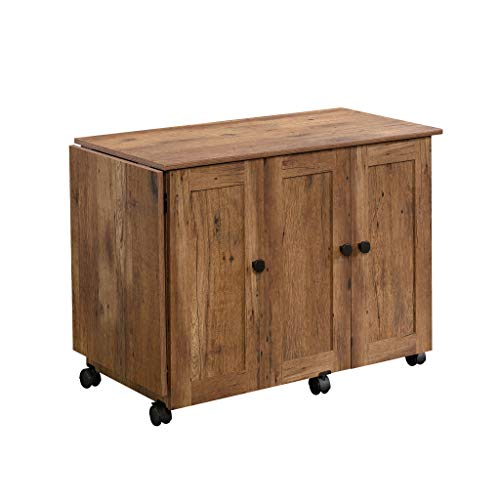
Crafters seeking a versatile workspace solution with ample storage will find the Sauder Miscellaneous Storage Sewing/Craft Cart in Vintage Oak Finish an ideal addition to their creative space. This mobile unit features a drop leaf that expands your work surface, while two bins, adjustable shelves, and a hidden sewing machine compartment maximize organization. Easy-roll casters enable effortless mobility throughout your workspace. With dimensions of 40.08″L x 19.45″W x 28.50″H and three storage levels, you’ll appreciate the cart’s practical height for comfortable crafting. Assembly takes approximately 2-3 hours. Boasting 4.6 stars from 4,692 reviews, it’s backed by a 5-year warranty.
Best For: Crafters and sewers who need a mobile, space-efficient storage solution with expandable workspace and organized compartments for supplies and equipment.
Pros:
- Drop leaf design provides expandable workspace while three storage levels with bins, adjustable shelves, and hidden sewing machine compartment maximize organization
- Easy-roll casters enable effortless mobility throughout your workspace, making it convenient to reposition as needed
- Excellent value with sturdy construction, comfortable working height, and strong customer satisfaction (4.6 stars from 4,692 reviews) backed by a 5-year warranty
Cons:
- Assembly required takes approximately 2-3 hours and requires careful attention to instructions for proper installation of hinges, casters, and doors
- Engineered wood construction may feel less durable than solid wood and surface shows fingerprints or smudges easily
- Some customers reported minor shipping damages such as chipping, suggesting packaging could be improved
BOWERY HILL Contemporary Engineered Wood Sewing Craft Table in Vintage Oak Finish

The BOWERY HILL Contemporary Engineered Wood Sewing Craft Table stands out with its versatile drop leaf design and ample storage solutions, making it ideal for hobbyists who need flexible workspace in compact areas. You’ll appreciate the easy-roll casters that let you reposition the 76-pound unit effortlessly. Behind the slab-style door, you’ll find two storage bins, a hidden shelf for your sewing machine, and two adjustable shelves. The vintage oak finish complements traditional and modern spaces alike. With a 4.6-star rating from 260 customers, users praise its sturdiness and aesthetic appeal, though assembly requires patience and several days to complete properly.
Best For: Hobbyists and crafters who need a mobile, space-saving sewing table with flexible storage options and the ability to expand their workspace when needed.
Pros:
- Drop leaf design and easy-roll casters provide excellent workspace flexibility and mobility for repositioning the 76-pound table
- Comprehensive storage with two bins, hidden sewing machine shelf, and two adjustable shelves behind a roll-open door
- Attractive vintage oak finish with sturdy construction that complements both traditional and modern décor styles
Cons:
- Assembly is time-consuming and challenging, with customers reporting it may take several days to complete
- Door magnets have been reported as problematic by some users
- Weight limit of 75 pounds is relatively low considering the table itself weighs 76 pounds
Arrow 611F Sewing Table for Singer Featherweight Machines 221 and 222
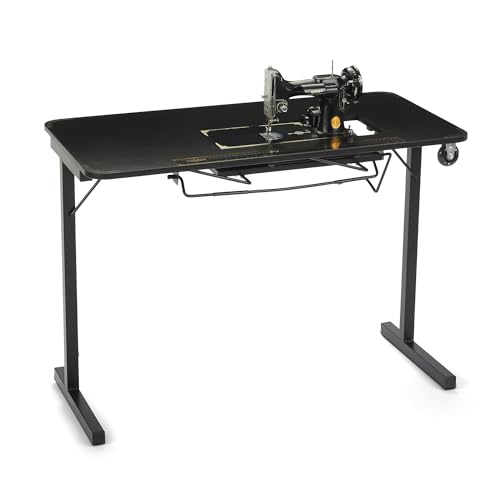
Owners of Singer Featherweight models 221 and 222 will find the Arrow 611F Sewing Table purpose-built for their vintage machines. Its 2-position manual lift creates a flush work surface for both free arm and flat bed sewing. The sturdy steel base minimizes vibration for straighter stitches, while built-in wheels provide mobility. You’ll appreciate its lightweight portability for workshops and easy storage under beds. However, some users report quality concerns including screws pulling out and collapsible legs caused by Velcro straps. Despite these issues, customer service promptly offers replacements for defective items, though you might consider custom alternatives for better durability.
Best For: Owners of vintage Singer Featherweight sewing machines (models 221 and 222) who need a portable, purpose-built table for workshops, retreats, and easy home storage.
Pros:
- 2-position manual lift creates flush work surface for both free arm and flat bed sewing positions specifically designed for Singer Featherweight models
- Sturdy steel base minimizes machine vibration for straighter stitches while built-in wheels provide excellent mobility
- Lightweight and portable design allows for easy storage under beds or in closets and convenient transport to workshops
Cons:
- Quality issues reported with screws pulling out from the material, requiring repairs for some users
- Design problems with collapsible legs caused by Velcro straps affecting overall sturdiness
- Some users suggest building custom tables instead due to concerns about overall product durability despite available customer service support
Arrow Sewing “Judy” Portable Folding Sewing Cabinet with Storage

Serious sewers who need a dedicated workspace but lack a permanent sewing room will find the Arrow Sewing “Judy” cabinet ideally suited to their needs. This portable cabinet features heavy-duty locking casters and measures 25.5 x 17.25 x 29.5 inches when closed. You’ll appreciate the 3-position hydraulic lift that adjusts your machine between free arm, flat bed, and storage positions. The cabinet accommodates standard machines up to 55 pounds and includes a door cubby for notions. While assembly takes 1-2.5 hours and some users report hydraulic lift installation challenges, the cabinet’s 10-year warranty and 4.4-star rating from 120 customers demonstrate its reliable performance.
Best For: Serious sewers who need a flexible, space-saving sewing workspace with hydraulic lift functionality but don’t have a dedicated sewing room.
Pros:
- 3-position hydraulic lift allows easy transitions between free arm, flat bed, and storage positions for versatile sewing options
- Heavy-duty locking casters provide excellent mobility and stability, making it easy to move and secure in place
- 10-year warranty and sturdy construction offer long-term value compared to cheaper alternatives
Cons:
- Assembly can be challenging and time-consuming (1-2.5 hours), particularly with hydraulic lift installation
- Particle board construction may lack durability during assembly and long-term use
- Some users experienced issues with door stability and shipping damages
Factors to Consider When Choosing a Vintage Sewing Machine With Cabinet
When you’re selecting a vintage sewing machine with cabinet, you’ll need to evaluate several practical factors that affect both functionality and placement in your home. Consider the cabinet’s size and dimensions to guarantee it fits your available space, while verifying the machine weight capacity matches your equipment. You should also examine the lift mechanism type, workspace expansion capabilities, and storage compartments to determine if the cabinet meets your organizational needs and sewing workflow.
Cabinet Size and Dimensions
Before investing in a vintage sewing machine with cabinet, you’ll need to carefully evaluate the physical dimensions to ascertain the piece works within your available space. Most cabinets require approximately 30 inches deep by 40 inches wide, though this varies by model. You’ll want to measure your designated workspace beforehand to ascertain a comfortable fit.
Pay attention to the cabinet’s height, which should ideally fall between 28 to 30 inches for ergonomic comfort during extended sewing sessions. Consider cabinets with adjustable features or expandable leaves that accommodate larger projects while maximizing your available space. Additionally, verify the cabinet can support your machine’s weight—many models handle up to 55 pounds or more, ascertaining stability during operation.
Machine Weight Capacity Limits
Understanding your machine’s weight becomes critical since vintage sewing machine cabinets typically accommodate models ranging from 45 to 65 pounds. You’ll need to verify your specific machine’s weight against the cabinet’s stated capacity to ascertain compatibility.
Select a cabinet with a robust lift mechanism that won’t wobble or become unstable during operation. Heavier machines require reinforced cabinet structures, particularly if you’re tackling multi-layer sewing projects that generate additional stress.
Pay attention to the cabinet’s material composition. Solid wood or quality engineered wood provides superior support compared to lighter alternatives. Cabinets with insufficient weight limits will restrict you to lighter models, potentially eliminating your preferred vintage machine from consideration. Always prioritize cabinets that exceed your machine’s weight requirements for long-term durability.
Lift Mechanism Type Options
How will you raise and lower your vintage sewing machine during daily use? The lift mechanism type directly affects your sewing experience and ease of shifting between flat bed and free arm modes.
Manual lifts offer a straightforward, cost-effective solution. You’ll adjust the machine height using a simple lever or hand crank, requiring minimal maintenance.
Hydraulic lifts use fluid pressure to raise and lower your machine with minimal effort. They provide smoother, more adjustable changes between positions compared to manual options.
Electric lifts deliver modern convenience at the push of a button. You’ll appreciate the effortless height adjustment that accommodates various preferences.
Regardless of type, verify the lift’s weight capacity supports your machine. Some systems handle machines up to 65 lbs.
Workspace Expansion Features Available
Three workspace expansion features transform a basic sewing cabinet into a versatile crafting station.
Look for expandable leaves, including rear quilt leaves and side leaves, that increase your workspace for larger projects while preventing fabric from dragging on the floor. You’ll appreciate cabinets with covers that create additional flat workspace when your machine is stored, offering versatility for various tasks.
If you’re considering mobile units, make sure they have locking mechanisms to maintain stability during sewing or crafting. Choose models with large lift openings that support standard sewing machines, enhancing accessibility and simplifying changes between flatbed and free arm positions. Removable trays and dedicated storage options keep your tools organized and within reach, maximizing workspace efficiency throughout your projects.
Storage Compartments and Organization
When selecting a vintage sewing machine cabinet, prioritize models with multiple storage compartments that keep your notions, tools, and fabric organized and accessible. Look for adjustable shelves and removable drawers that let you customize storage according to your specific supplies and accessories. A hidden shelf for the machine itself maintains a tidy workspace while ensuring quick access when you’re ready to sew.
Evaluate additional features like embroidery spool holders and dedicated thread and bobbin compartments—these streamline your setup and minimize clutter. The cabinet’s overall layout matters greatly; you’ll want everything within easy reach to enable efficient multitasking. Well-designed storage compartments transform your vintage cabinet into a functional workspace that enhances both organization and your overall sewing experience.
Assembly Requirements and Difficulty
Assembly complexity deserves careful consideration before you purchase a vintage sewing machine with cabinet, as setup times can stretch from a quick afternoon project to a multi-hour endeavor requiring patience and precision. You’ll often encounter unclear instructions and misaligned pre-drilled holes that can frustrate even experienced assemblers. Plan to recruit at least one helper, especially when handling heavier components, to guarantee stability and prevent potential injuries.
Before starting, verify that you’ve got all necessary tools and hardware, as some packages don’t include everything required. The assembly process notably impacts your overall satisfaction, so read customer reviews carefully to identify models with well-designed instructions and properly aligned parts. Poor assembly experiences can overshadow even the most beautiful vintage machines.
Material Durability and Construction
The longevity of your vintage sewing machine cabinet hinges directly on its construction materials and build quality. Prioritize solid wood or heavy-duty engineered wood over lightweight alternatives, as these materials deliver superior stability and durability. Since vintage machines contain substantial metal components, you’ll need a cabinet with a high weight capacity—this indicates robust construction that’ll support your equipment reliably.
Examine the cabinet’s structural features carefully. Look for locking wheels and heavy-duty casters that provide both stability during operation and easy mobility for storage. Choose designs with hydraulic lifts or sturdy frames that minimize vibration, which directly impacts your stitching precision. Additionally, verify assembly requirements beforehand. Complex assembly procedures can compromise structural integrity if executed incorrectly, undermining the cabinet’s long-term performance and durability.